Generative AI: How LLMs and Diffusion Models Work
Discover the fascinating science behind Generative AI. Learn how Large Language Models (LLMs) like ChatGPT generate text and how Diffusion Models create stunning images.
Discover the fascinating science behind Generative AI. Learn how Large Language Models (LLMs) like ChatGPT generate text and how Diffusion Models create stunning images.
Artificial Intelligence has transitioned from analyzing data to creating it. We are now in the era of Generative AI, a paradigm shift where machines can write poetry, write functional code, and generate photorealistic images from simple text descriptions. But what exactly is happening under the hood? How can a computer program exhibit creativity?
The secret lies in two groundbreaking architectures: Large Language Models (LLMs) and Diffusion Models. These models may look like magic or an intelligent person sitting inside, but these are based in mathematical equations, statistics, massive datasets and huge computational power. Let us take a deeper look at this technology, which is changing the todays digital world.
Traditional machine learning excels at pattern recognition. For example, a traditional AI can look at a thousand pictures of cats and learn to identify a cat in a new photo. Generative AI, on the other hand, learns the underlying distribution of the data. Instead of just recognizing a cat, it learns the “essence” of what a cat looks like, enabling it to generate a brand new image of a cat that has never existed.
This capability stems from deep learning models with billions, and sometimes trillions, of parameters. By analyzing vast datasets, these models build complex internal representations of language, visual structures, and even logical reasoning.
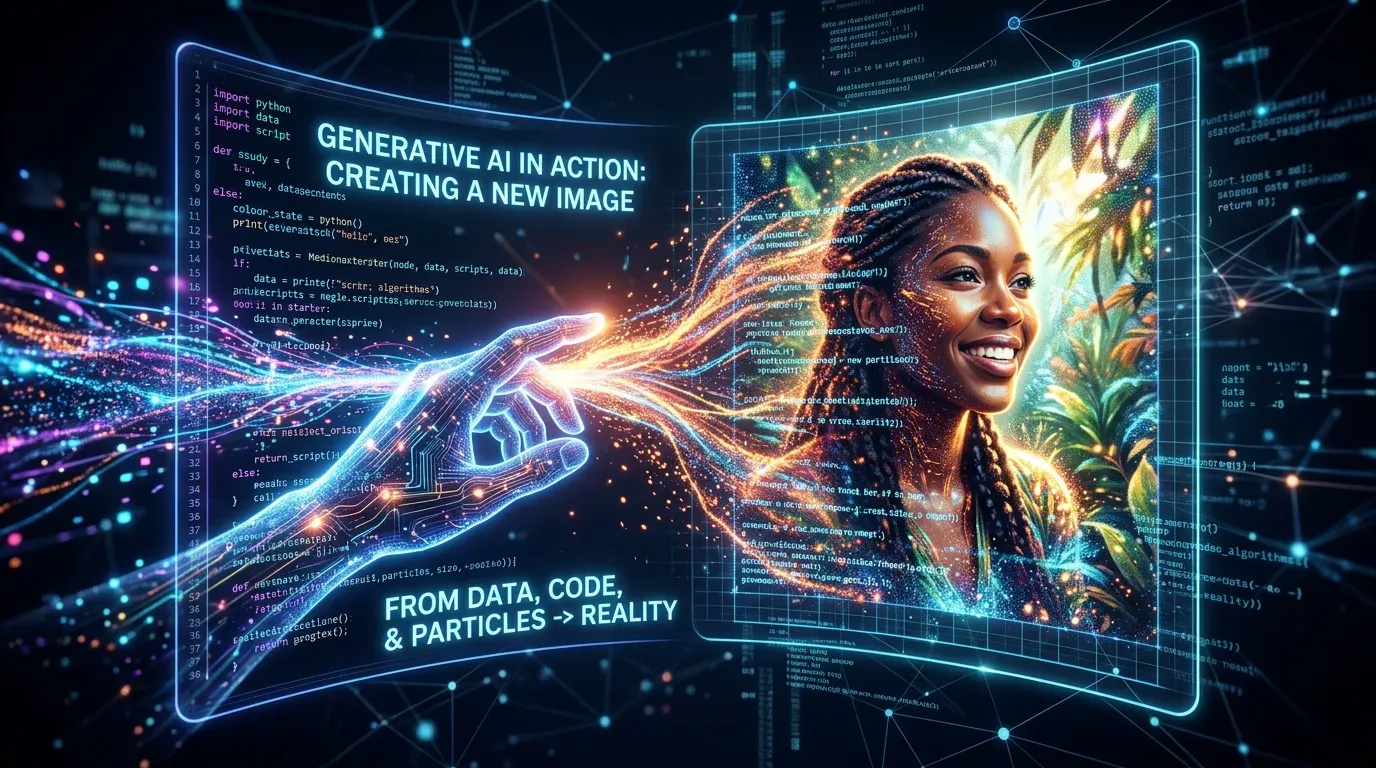
Large Language Models, such as GPT-4, Claude, and Gemini, are the powerhouses behind modern chatbots and text generators. At their core, LLMs are incredibly advanced autocomplete engines. Their primary function is to predict the most likely next word (or token) given a sequence of preceding words.
The turning point for natural language processing occurred in 2017 with the introduction of the Transformer architecture by Google researchers. Before Transformers, models processed text sequentially (word by word), making it difficult to understand context in long sentences.
Transformers introduced a mechanism called Self-Attention. This allows the model to look at every word in a sentence simultaneously and weigh their importance relative to each other. For example, in the sentence “The bank of the river,” the self-attention mechanism helps the model understand that “bank” refers to a natural feature rather than a financial institution by heavily weighing the word “river.”
Developing a state-of-the-art LLM involves a rigorous multi-stage pipeline:
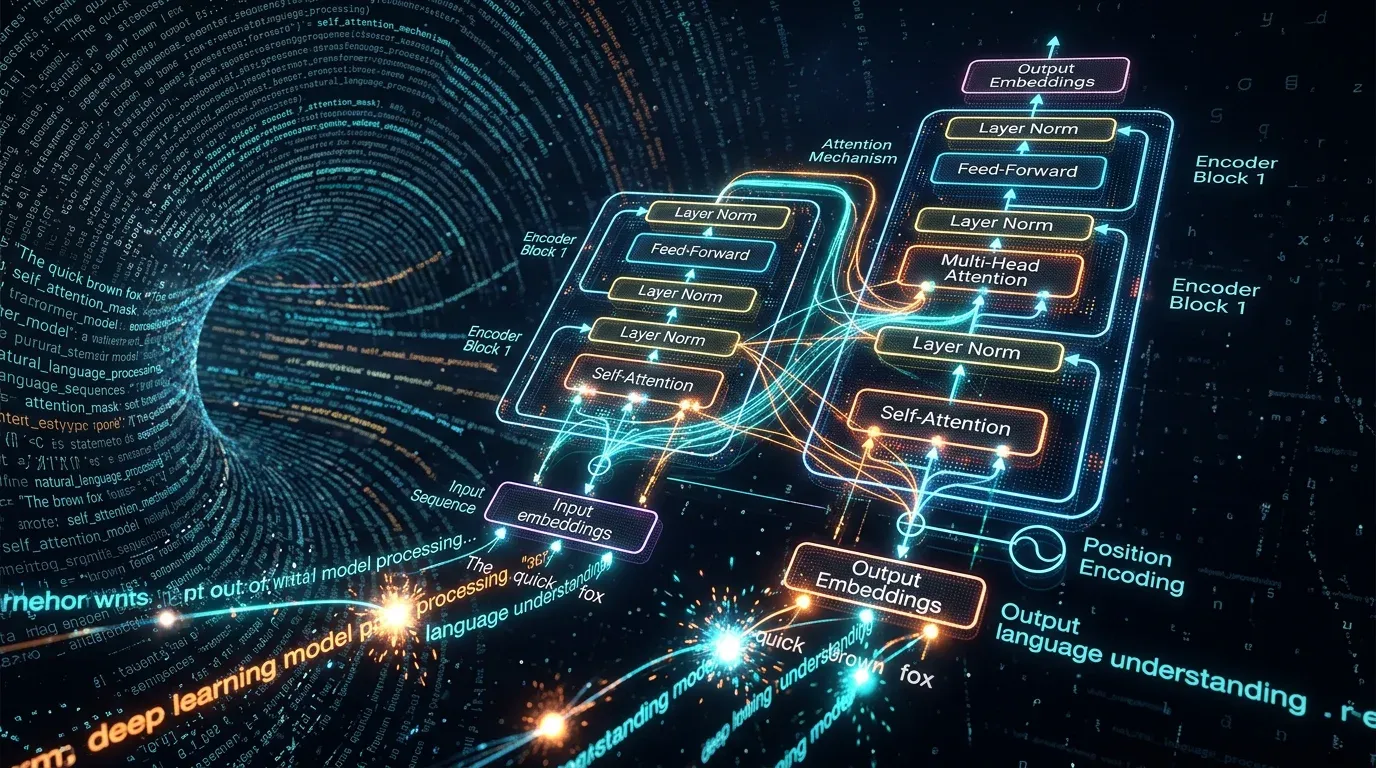
While LLMs specializes in the prediction of next token or text prediction, Diffusion Models dominate the area of image generation. Systems like Midjourney, DALL-E 3, and Stable Diffusion leverage this architecture to turn text prompts into stunning visuals.
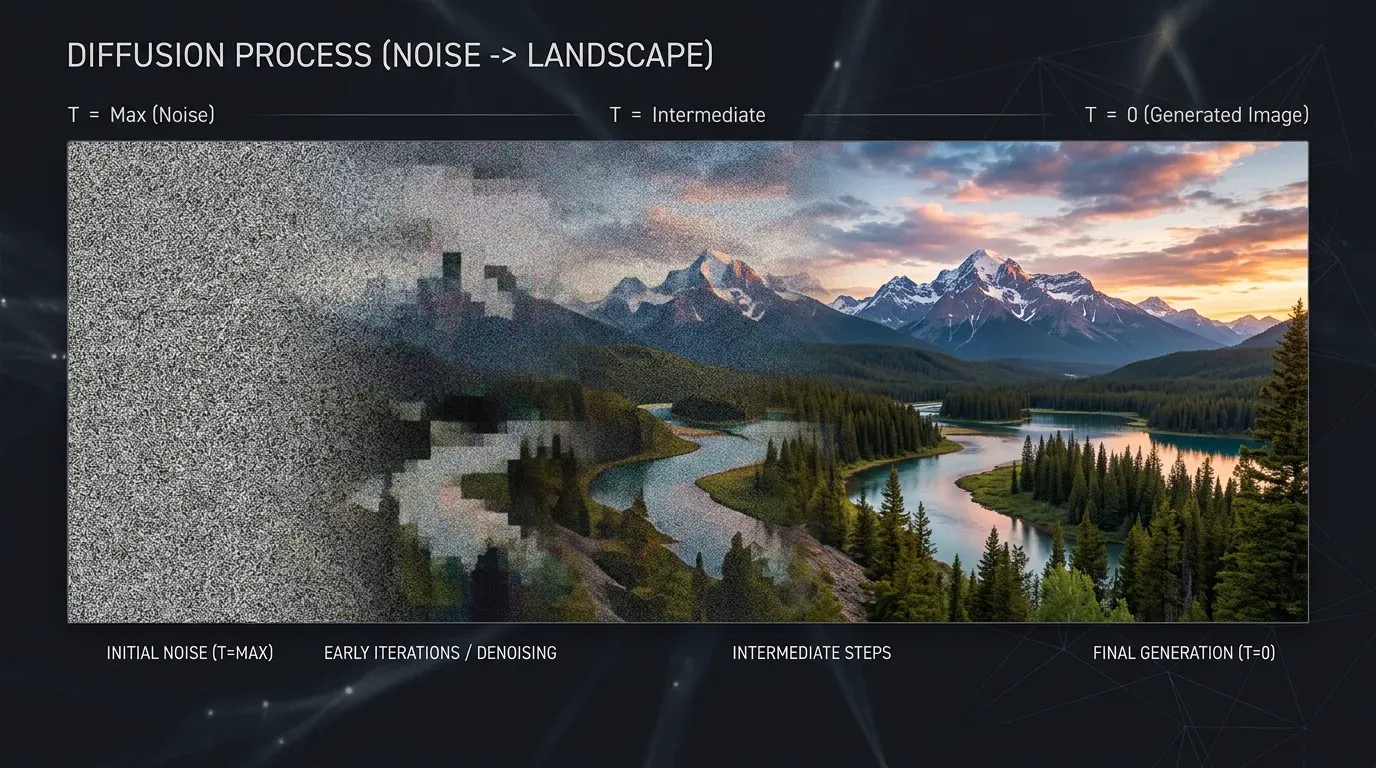
Diffusion models operate on a surprisingly counterintuitive principle: they learn to create by first learning to destroy.
The training process involves two main phases:
Once trained, the model can generate entirely new images from scratch. When you input a text prompt (e.g., “An astronaut riding a horse on Mars”), the model starts with a canvas of pure random noise. Guided by the text prompt, it slowly applies its reverse diffusion process, iteratively sculpting the static into a coherent image that matches your description.
We all are using Generative AI in our everyday life as well and it is changing and evolving the industries as we speak:
No. Generative AI models are complex statistical algorithms. They do not possess consciousness, emotions, or true understanding; they simply recognize and replicate patterns from their training data.
A parameter is a numerical value inside the neural network that changes during training. You can think of parameters as the microscopic connections that store the model's knowledge. Modern LLMs have billions or trillions of them.
Hands are highly complex, with many joints and variations in pose. Because hands appear in diverse and often occluded positions in training data, the model struggles to map the precise, logical geometry of fingers during the diffusion process.