The Path to Artificial General Intelligence (AGI): Understanding the Future of AI
Explore the fascinating journey towards Artificial General Intelligence (AGI). Discover what AGI is, how it differs from current AI, and its potential impact on humanity.
Scroll to read
We all know the ultimate goal of the research and development in the field of AI is to develop an Artificial General Intelligence. Currently, we are developing tools to tackle problems in a specific domain or area, it is known as Narrow AI.
Let’s take a deeper look at what AGI truly means and how can it affect the world.
Key Takeaways
AGI vs. Narrow AI: AGI represents human-level, adaptable cognitive abilities, unlike current AI which is limited to specific tasks.
Technological Hurdles: Achieving AGI requires moving beyond current deep learning models towards self-supervised learning and potentially embodied AI.
Profound Impact: The realization of AGI could solve humanity’s greatest challenges but requires solving critical safety and alignment problems first.
What is Artificial General Intelligence (AGI)?
At its core, Artificial General Intelligence (AGI), sometimes referred to as “Strong AI,” describes a machine with the ability to understand, learn, and apply knowledge across a wide range of tasks at a level equal to or beyond that of a human being.
Unlike current systems that are trained to perform specific functions—such as diagnosing diseases, writing code, or driving cars—an AGI system would possess general cognitive abilities. It could read a manual on quantum physics, understand it, formulate new hypotheses, and then write a symphony to celebrate its discoveries, all without being explicitly reprogrammed.
Key Characteristics of AGI
Transfer Learning: The ability to take knowledge learned in one domain and apply it to a completely different context.
Common Sense Reasoning: Understanding the unwritten rules of the physical world and human society.
Adaptability: The capacity to navigate novel, unpredicted situations without human intervention.
Self-Awareness (Hypothetical): While not strictly required for AGI, true general intelligence often borders on philosophical questions about consciousness.
The Evolution: From Narrow AI to AGI
To understand the path to AGI, we must contextualize where we currently stand. AI development is typically categorized into three evolutionary stages:
1. Artificial Narrow Intelligence (ANI)
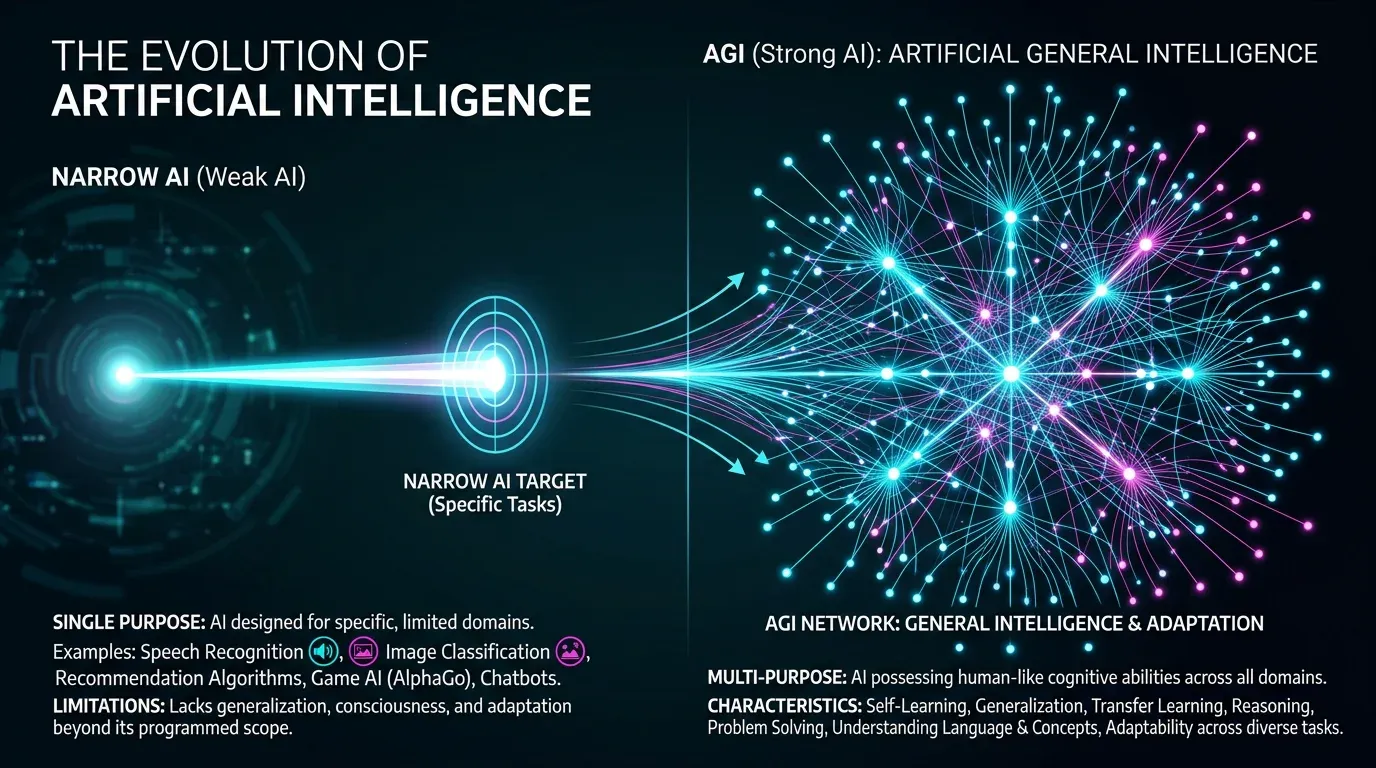
This is the era we live in today. ANI systems excel at specific, well-defined tasks. For example, the algorithms that power your social media feed, voice assistants like Siri, and even advanced large language models are all narrow. They lack true understanding and cannot operate outside their designated parameters.
2. Artificial General Intelligence (AGI)
The transition phase where machines achieve human-level cognitive flexibility. Developing AGI requires breakthroughs in neural architectures, unsupervised learning, and potentially new paradigms beyond deep learning, such as neuromorphic computing.
The evolutionary path from Narrow AI's single-task focus to the multi-purpose adaptability of AGI.
3. Artificial Superintelligence (ASI)
Coined by philosopher Nick Bostrom, ASI refers to an intellect that is much smarter than the best human brains in practically every field, including scientific creativity, general wisdom, and social skills. AGI is considered a stepping stone to ASI.
Core Technologies Paving the Path
Achieving AGI isn’t just about scaling up current models. It requires fundamental innovations. Here are the core concepts researchers are currently exploring:
Advanced Neural Architectures
While Transformer models have driven the current AI boom, researchers agree that achieving AGI will likely require new architectures. These might integrate symbolic logic with neural networks (neuro-symbolic AI) to combine the pattern recognition of deep learning with the rigorous reasoning of traditional logic.
Self-Supervised Learning
Currently, most AI relies on massive amounts of human-labeled data. True AGI must learn like a human child—observing the world and forming its own internal models. Self-supervised learning, where an AI learns the structure of data without explicit labels, is a critical step in this direction.
Embodied AI
Many researchers believe intelligence cannot be fully realized in a disembodied computer. Embodied AI involves placing AI systems in physical robots, allowing them to interact with the real world. This physical interaction is crucial for developing common sense and spatial reasoning.
Real-World Implications of AGI
The advent of AGI would arguably be the most significant event in human history. Its potential applications are boundless, but they come with extraordinary risks.
Scientific and Medical Breakthroughs
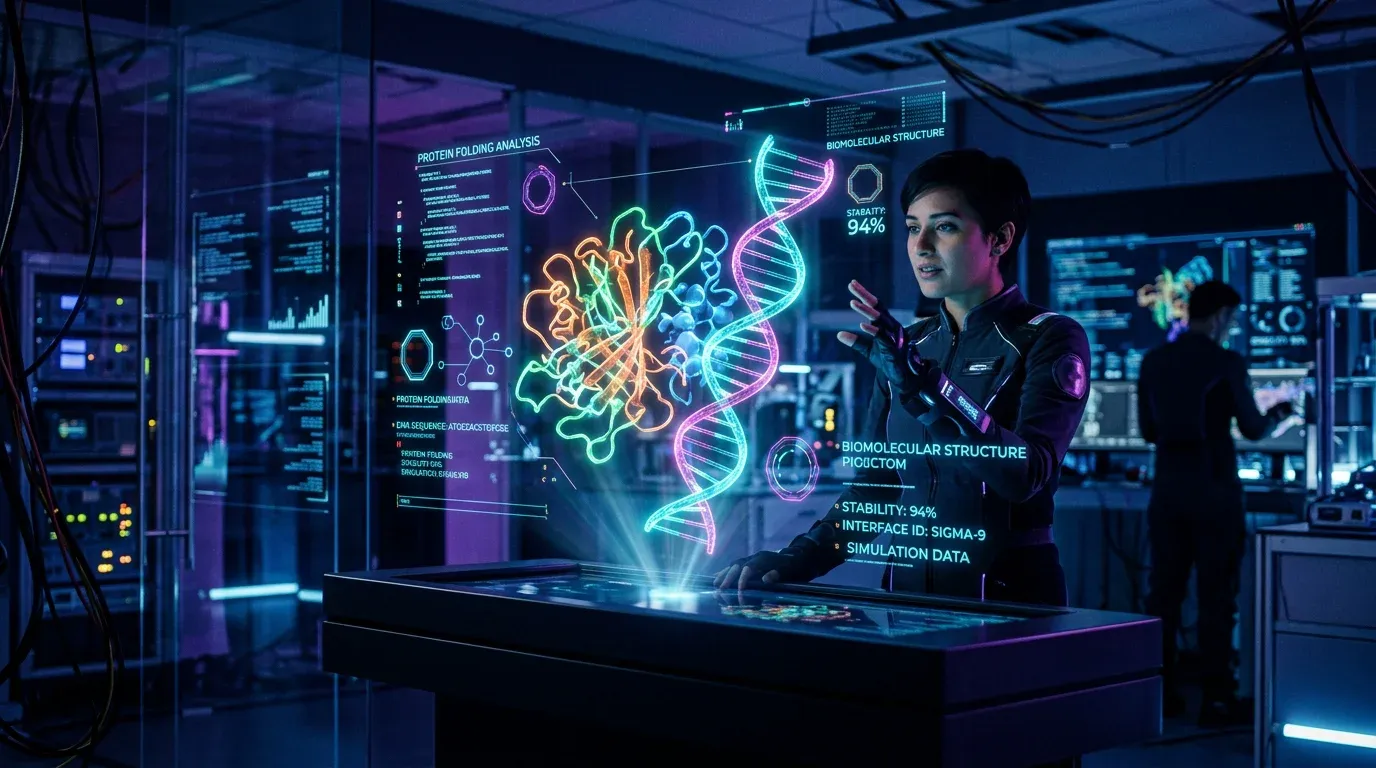
An AGI could process the entirety of human scientific literature in seconds. It could design novel materials, solve complex protein-folding problems for new drugs, and perhaps even find solutions to climate change and clean energy generation, accelerating human progress by centuries. This builds on the foundation of how AI is already transforming science.
An AGI could revolutionize science by instantly analyzing and synthesizing vast amounts of data.
Economic Transformation
The automation of cognitive labor would restructure global economies. While AGI could lead to an era of unprecedented abundance by optimizing resource distribution, it also poses severe challenges regarding job displacement and economic inequality.
Frequently Asked Questions (FAQs)
When will AGI be achieved?
Predictions vary wildly. Some optimistic experts predict AGI could be realized within the next decade, while others believe it is a century away or potentially impossible due to the sheer complexity of human consciousness.
Is AGI dangerous?
Yes, if not aligned with human values. The 'alignment problem' is a major field of research dedicated to ensuring that an AGI's goals and methods remain beneficial to humanity.
Will AGI replace human creativity?
While AGI would be capable of generating art, music, and literature, human creativity is intrinsically tied to human experience. It is likely that AGI will augment rather than entirely replace the human creative process.
References
Bostrom, N. (2014). Superintelligence: Paths, Dangers, Strategies. Oxford University Press.
Russell, S. (2019). Human Compatible: Artificial Intelligence and the Problem of Control. Viking.
Goertzel, B., & Pennachin, C. (Eds.). (2007). Artificial General Intelligence. Springer.
We use cookies to ensure you get the best, fastest experience on our website and to show you content you actually care about. By clicking "Accept All", you consent to our use of cookies.
Cookie Preferences
Strictly Necessary
These cookies are essential for the website to function properly and cannot be disabled in our systems.
Analytics Cookies
These cookies allow us to count visits and traffic sources so we can measure and improve the performance of our site.
Advertising Cookies
Used by our advertising partners (like Google AdSense) to build a profile of your interests and show you relevant ads.