Demystifying Neural Networks: How AI Actually Learns
Discover how neural networks function, the core concepts of artificial intelligence, and how machines learn from data to solve complex problems.
Discover how neural networks function, the core concepts of artificial intelligence, and how machines learn from data to solve complex problems.
Artificial Intelligence (AI) seems to be everywhere today, powering everything from digital assistants and self-driving cars to groundbreaking medical research. At the heart of this revolution is a specific type of technology known as the neural network. But what exactly is a neural network, and how does it enable a machine to “learn”?
The traditional computer programs follows strict, hand written rules. It works good if the problem we solve comes under its rules, but if there’s something which is not covered by program rules, traditional computer program failes. That is the weakness of traditional comptuer programs.
Real world problems are diverse, there’s no single rule that fits all. We needed to create something that can learn the underlying pattern instead of hard coded rules. That’s when neural networks came into light.
The first neural network was created by Warren McCulloch and Walter Pitts. They created the first mathematical model of an artificial neuron in 1943.
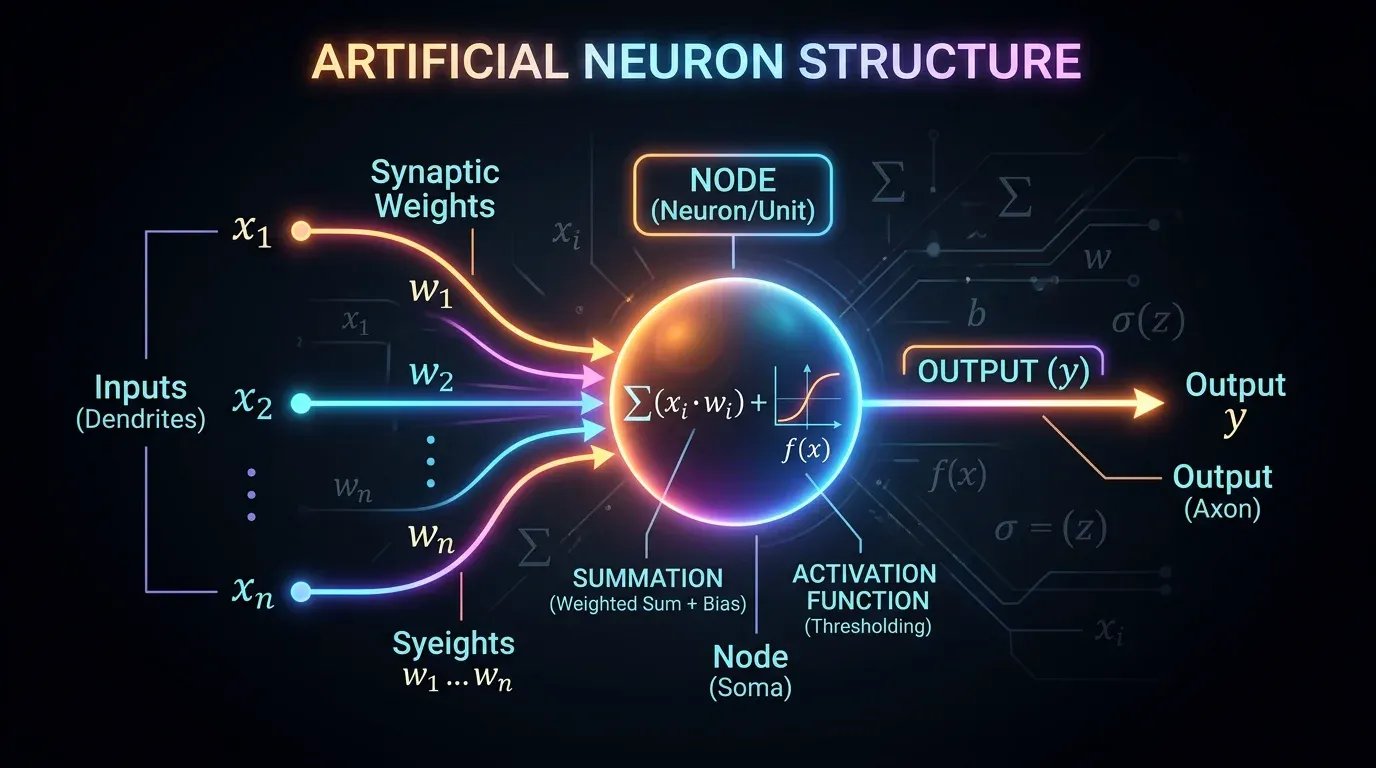
To understand how AI learns, we first need to look at the architecture of a neural network. These systems are inspired by the human nervous system, specifically the interconnected web of neurons in the brain.
At the base level, a neural network is made up of artificial neurons, often called nodes. Each node is a simple mathematical function. It receives input data, assigns it a specific weight (which determines its importance), adds a bias (a constant value to shift the result), and then passes the sum through an activation function. The activation function decides whether the node should “fire” or pass its signal to the next layer.
Nodes are organized into layers:
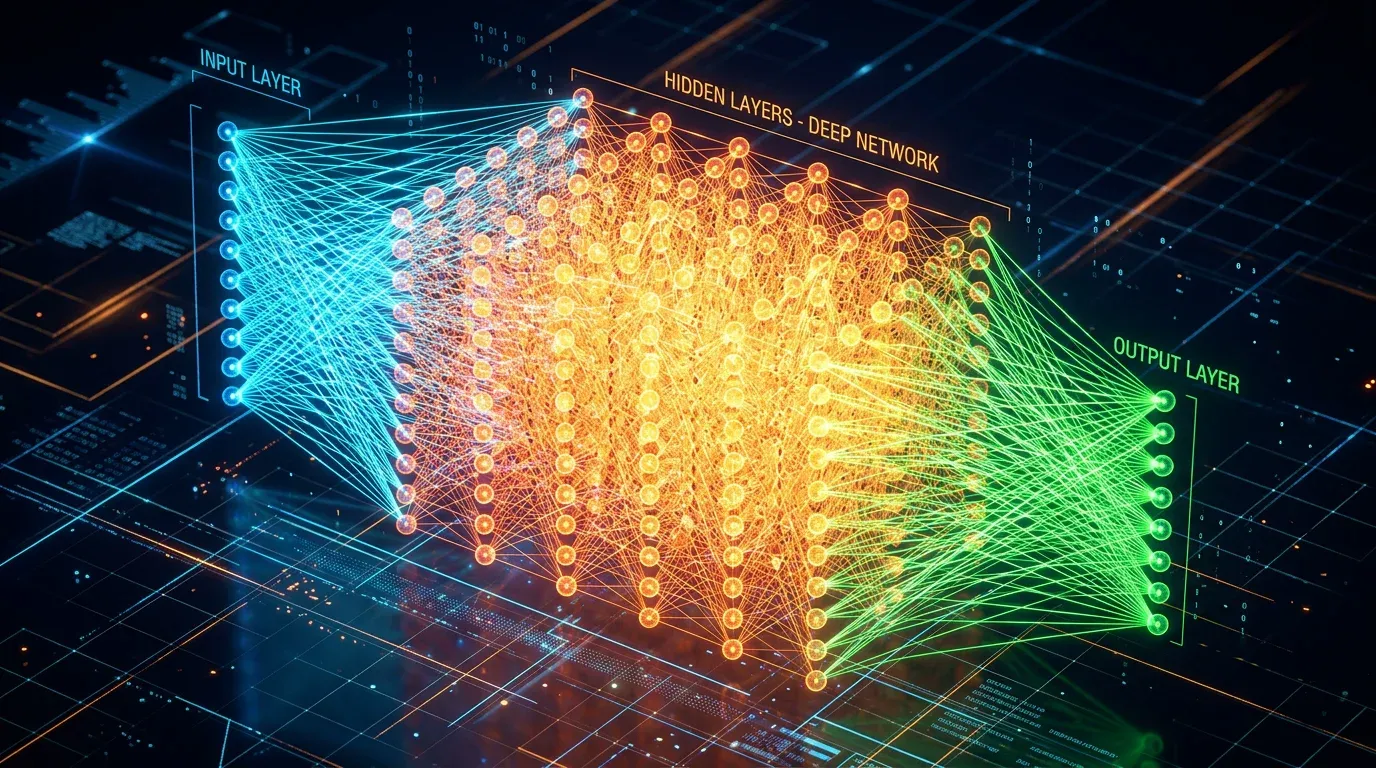
When a neural network is first initialized, its weights and biases are set randomly. Predictably, its first attempts at any task are usually wrong. This is where the learning process begins.
The network compares its output to the correct answer (the “ground truth”) and calculates the error using a loss function. Then, a process called backpropagation (backward propagation of errors) kicks in. The network works backward from the output layer to the input layer, tweaking the weights and biases of each node to minimize the error. By repeating this process thousands or millions of times over massive datasets, the network gradually improves its accuracy. This iterative training is the core of how to learn machine learning and artificial intelligence.
Neural networks has been applied to many real world problems. There may not be even a single domain in the world, which has not come in touch with neural networks. It is helping us to solve a lot of problem very fast which otherwise wouldn’t be possible.
If you’ve ever used a facial recognition system to unlock your phone or asked a voice assistant to set a timer, you’ve interacted with a neural network. Convolutional Neural Networks (CNNs) are particularly adept at processing visual data, while Recurrent Neural Networks (RNNs) and Transformers excel at understanding spoken and written language.
AI is proving to be a powerful tool for researchers. From predicting protein structures to identifying potential new drugs, neural networks can analyze complex biological data faster than traditional methods. As we explore how AI is transforming science, the impact on accelerating discoveries becomes undeniable.
Self-driving cars rely on deep neural networks to process data from cameras, radar, and LIDAR sensors in real-time. The network must instantly classify objects—such as pedestrians, other vehicles, and traffic signs—and make split-second decisions on how to navigate safely.

No. While inspired by biological brains, artificial neural networks are vastly simplified mathematical models. They require massive amounts of data to learn specific tasks, whereas humans can learn from just a few examples and generalize across different domains.
AI is the overarching concept of machines simulating human intelligence. Machine Learning is a subset of AI where systems learn from data. Deep Learning is a further subset of Machine Learning that specifically uses multi-layered neural networks.
Because deep neural networks have millions or billions of parameters, it can be extremely difficult to trace exactly why they made a specific decision. This lack of interpretability is an active area of research known as Explainable AI (XAI).